
If you’ve noticed uneven concrete around your home—whether it’s a sinking driveway, patio, or sidewalk—you may have heard about polyurethane foam as a modern solution. But some may be wondering what exactly this material is, and why has it become the go-to method for concrete lifting?
Let’s dive a little deeper and take a closer look at what’s inside the foam and why it’s such a powerful tool for restoring and stabilizing concrete.
Understanding Polyurethane Foam
Polyurethane foam is a high-performance material created through a chemical reaction between two primary components: polyols and isocyanates. When these substances are combined, they react rapidly, expanding into a rigid foam that hardens in place.
This expansion is what makes polyurethane foam so effective for lifting concrete. As the foam grows, it fills empty spaces beneath slabs and gently raises them back to their original position.
The Core Components Explained
-
Polyols – The Structural Base
Polyols are liquid compounds that form the foundation of polyurethane foam. They help determine the foam’s flexibility, density, and overall performance. In concrete lifting applications, specially formulated polyols are used to create dense, durable material capable of supporting heavy loads.
-
Isocyanates – The Reactive Element
Isocyanates are highly reactive chemicals that combine with polyols to create the foam structure. This reaction forms strong polymer chains, giving the foam its rigidity and strength once cured.
-
Blowing Agents – Creating Expansion
Blowing agents are responsible for the foam’s expansion. When the chemical reaction occurs, these agents release gas, forming millions of tiny bubbles within the material. This cellular structure allows the foam to expand quickly while remaining lightweight.
-
Catalysts – Speed and Control
Catalysts regulate how fast the reaction occurs. In slabjacking, timing is critical—the foam must expand quickly enough to lift concrete efficiently, but not so fast that it becomes uncontrollable.
-
Surfactants – Consistency and Stability
Surfactants help control the size and distribution of the foam’s bubbles. This ensures a consistent structure, which directly impacts the foam’s strength and reliability.
-
Additives – Performance Enhancers
Depending on the application, additional ingredients may be included to enhance performance. These can improve moisture resistance, durability, and long-term stability, especially important in environments with shifting soil or water exposure.
Why Polyurethane Foam Works So Well
Polyurethane foam isn’t just popular, it’s highly effective for several key reasons:
- Lightweight but Strong: It won’t add unnecessary weight to already unstable soil
- Expands to
- : Reaches areas traditional methods can’t
- Fast Curing: Ready for use in a matter of minutes
- Water-Resistant: Helps prevent future erosion and washout
- Precision Lifting: Allows controlled, accurate slab leveling
Because of these benefits, polyurethane foam has become a preferred alternative to traditional mudjacking or full slab replacement.
The Role of Foam in Concrete Lifting
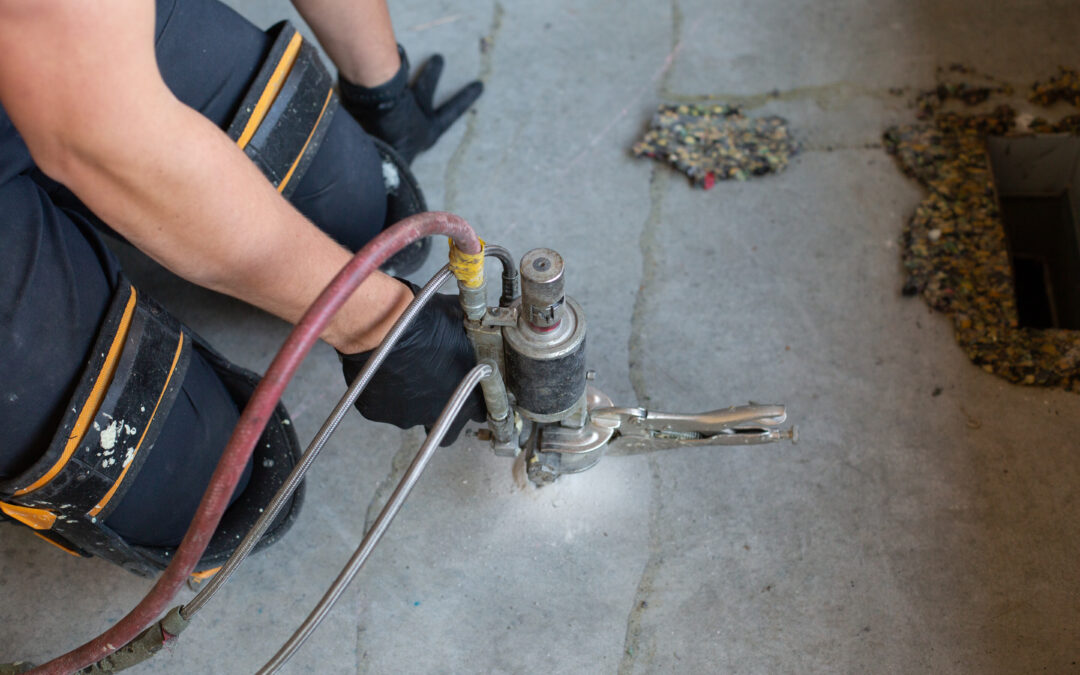
When concrete begins to sink, it’s usually due to soil erosion, compaction, or voids beneath the slab. Polyurethane foam is injected through small holes drilled into the concrete. Once inside, it expands, fills the gaps, and applies upward pressure—lifting the slab back into place.
At the same time, the foam stabilizes the surrounding soil, helping prevent future movement.
A Smarter, Longer-Lasting Solution
Modern concrete lifting with polyurethane foam is not just about fixing what’s visible, it’s about addressing the root cause of the problem. By filling voids and reinforcing the ground beneath your concrete, this method delivers long-term stability with minimal disruption.
Get a Free Estimate from Sealtite Insulation & Slabjacking
If you’re dealing with sinking or uneven concrete, don’t wait for the problem to get worse. Sealtite Insulation & Slabjacking uses advanced polyurethane foam technology to restore your surfaces quickly, safely, and effectively.
👉 Contact Sealtite today to request your FREE estimate and see how modern concrete lifting can protect and improve your property.
Take the first step toward a safer, more stable home, your concrete (and your foundation) will thank you.